


You can always tell.
That email that starts with “I hope this message finds you well” and then “delves into” something while promising to help you “navigate the landscape.”
The Instagram caption that sounds like it was written by a corporate HR department having an identity crisis.
The sales page that uses “leverage” four times and “unlock your potential” three more.
It’s AI content. And it’s painfully obvious.
Here’s the thing… wait, no. I’m not starting with “here’s the thing” because that’s ALSO a dead giveaway. 🙄
Look, AI is an incredible tool. I use it every single day in my business. But there’s a massive difference between using AI well and publishing robot content that makes your audience cringe.
The entrepreneurs who sound robotic aren’t using AI wrong because AI is bad. They’re making specific, fixable mistakes that strip all the personality out of their content.
Let me show you the five biggest offenders and exactly how to fix each one.
Mistake #1: Letting AI Generate Your Ideas
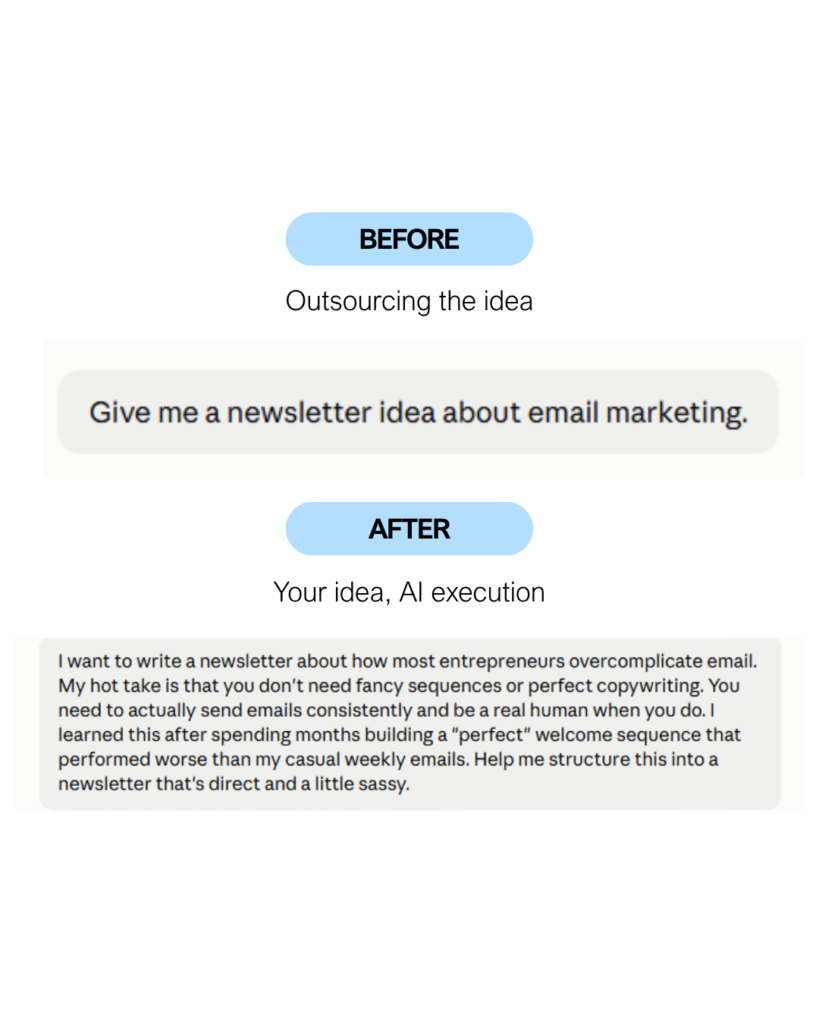
The problem: You’re asking AI “what should I write about?” instead of bringing your own ideas and letting AI help execute them.
This is the mistake I see most often. And it’s the one that does the most damage.
When you start with a blank prompt like “give me 10 newsletter ideas” or “what should my next Instagram post be about,” you’re outsourcing the ONE thing that makes your content uniquely yours.
AI pulls from patterns in its training data. Which means it gives you ideas that are… average. Common. The same things everyone else is writing about.
Your original thoughts, your unique experiences, your hot takes, your lessons learned from actual work with actual clients? AI doesn’t have access to those. Only you do.
When you let AI generate ideas, you end up in the sea of sameness. Your content sounds like everyone else’s because it literally came from the same source.
The Robot Version:
Prompt: “Give me a newsletter idea about email marketing.”
AI output: “Write about the importance of building an email list and how it can help grow your business. Discuss best practices for email marketing and tips for increasing open rates.”
Groundbreaking stuff. 🙄
The Fix:
YOU come up with the idea first. It can be rough. It can be a half-formed thought. But it needs to come from YOUR brain.
Then use AI to help structure, expand, and polish.
Prompt: “I want to write a newsletter about how most entrepreneurs overcomplicate email. My hot take is that you don’t need fancy sequences or perfect copywriting. You need to actually send emails consistently and be a real human when you do. I learned this after spending months building a ‘perfect’ welcome sequence that performed worse than my casual weekly emails. Help me structure this into a newsletter that’s direct and a little sassy.”
See the difference? The idea, the angle, the personal experience, the perspective—that all came from you. AI just helps you communicate it better.
Your ideas. AI execution. Always.
Mistake #2: No Brand Voice Training
The problem: You’re using AI without ever teaching it how you actually sound, so it defaults to generic, corporate-speak output.
AI doesn’t know you. It doesn’t know your audience. It doesn’t know that you’d never say “synergy” or that you love a good pop culture reference or that your sentences tend to be short and punchy.
So it guesses. And its guesses sound like… everyone. Bland. Safe. Forgettable.
This is why so much AI content has that “written by AI” smell. Not because AI can’t write well, but because nobody taught it how to write like THEM.
The Robot Version:
“We’re excited to announce our new program that will help you navigate the ever-changing landscape of digital marketing. Dive in and discover how to leverage cutting-edge strategies to unlock your business potential.”
I threw up in my mouth a little just writing that.
The Fix:
Create a Brand Book that captures your voice, your audience, your offers, and your personality. Then feed it to AI at the start of every conversation.
Your Brand Book should include:
- Words and phrases you love
- Words and phrases you’d NEVER use (looking at you, “delve”)
- Your tone and communication style
- How you handle humor, controversy, vulnerability
- Specific examples of your writing that capture your voice
When AI knows that you’re “direct, a little sassy, with short paragraphs and zero corporate jargon,” suddenly the outputs sound like you actually wrote them.
Same prompt, with Brand Book context:
“Okay so the new program is live. It’s for entrepreneurs who are sick of overcomplicating their marketing and want simple systems that actually work. No fluff, no jargon, just the stuff that moves the needle. If you’ve been spinning your wheels with tactics that don’t convert, this is for you.”
Night and day.
Grab the 2-Hour Brand Book and build yours this week →

Mistake #3: Prompts That Are Way Too Vague
The problem: You’re giving AI almost nothing to work with, then wondering why the output is generic garbage.
“Write me a caption.”
“Help with my sales page.”
“Create some content.”
These aren’t prompts. They’re prayers. You’re hoping AI will read your mind and magically know what you want.
Spoiler: it won’t.
AI is like a new team member who’s eager to help but knows absolutely nothing about your business. If you gave a human assistant that little direction, you’d get terrible results too.
The Robot Version:
Prompt: “Write me a social media caption about my course.”
AI output: “Ready to take your skills to the next level? 🚀 Our comprehensive course is designed to help you achieve your goals and unlock your full potential. Click the link in bio to learn more! #entrepreneur #courselaunch #success”
Generic. Forgettable. Sounds like every other post in the feed.
The Fix:
Be specific. Give AI the context it needs:
- What exactly are you promoting?
- Who is this for?
- What’s the main message or angle?
- What tone should it have?
- What should it NOT include?
- How long should it be?
- Is there a specific CTA?
Better prompt: “Write an Instagram caption promoting my Email Fix course. Audience is female entrepreneurs who know they should be emailing their list but find it overwhelming. Angle: stop overcomplicating email, just be consistent and be human. Tone: casual, direct, a little sassy. No hashtags, no emojis except maybe one. Around 100 words. CTA is to comment ‘EMAIL’ for the link.”
Now AI has something to work with.
Mistake #4: Using Basic Chat for Repeated Tasks
The problem: You’re re-explaining your entire business every single time you use AI, instead of building trained assistants for tasks you do regularly.
There’s nothing wrong with using regular AI chat for one-off tasks or brainstorming. Sometimes you just need a quick answer or a sounding board.
But if you’re doing the same types of tasks repeatedly—writing newsletters, creating social captions, drafting client emails, producing podcast show notes—and you’re starting from scratch every time?
You’re wasting hours.
Every conversation, you’re re-explaining your brand voice, your audience, your offers, your tone preferences. The AI forgets everything the moment that chat ends. It’s like training a new employee from zero, every single day.
The Robot Version:
Week 1: “I run an online business for course creators. My voice is casual and direct. Please write me a newsletter about…”
Week 2: “I run an online business for course creators. My voice is casual and direct. Please write me a newsletter about…”
Week 3: Same thing.
Week 47: Still the same thing.
This is madness.
The Fix:

For repeated tasks, build trained AI assistants.
Create a custom GPT (in ChatGPT) or use Claude Projects to build assistants that already know:
- Your Brand Book and voice guidelines
- Your audience insights
- Your offers and how to talk about them
- Examples of your best work
- Specific instructions for that type of task
Now when you need a newsletter, you don’t re-explain everything. You just say “write a newsletter about X” and the assistant already knows the rest.
I have different trained assistants for email writing, social content, podcast production, sales copy, and more. Each one knows my brand deeply. Each one produces on-brand content without me having to explain myself every time.
This is the difference between using AI as a tool and having AI as a team member.
Mistake #5: Publishing Raw AI Output Without Human Review
The problem: You’re hitting “generate” and then copying straight to publish without actually reading, editing, or adding your personal touch.
I get it. The whole point of AI is to save time. And reviewing everything feels like extra work.
But here’s what happens when you skip review:
- AI makes stuff up (it’s called hallucination, and yes, it happens)
- Subtle off-brand phrases slip through
- The content lacks your specific examples and stories
- Weird repetition or awkward transitions stay in
- You publish something you’d never actually say
And your audience notices. Maybe not consciously, but something feels… off. The content doesn’t hit the same. Engagement drops. Trust erodes.
The Robot Version:
AI writes: “In my extensive experience working with thousands of clients, I’ve discovered that the key to success lies in consistent implementation of proven strategies.”
You publish it without reading.
Your audience: “…did Gemma write this? This doesn’t sound like her at all.”
The Fix:
Always do a human review. But make it fast.
I’m not talking about rewriting everything. I’m talking about a quick pass to:
- Catch any obvious AI-isms or phrases you’d never use
- Add a personal story or example that makes it yours
- Fix anything factually wrong or off-brand
- Make sure the CTA is right
- Read it once out loud to check flow
This takes 5-10 minutes. It’s the difference between “AI-assisted content” and “AI-generated content.”
Your audience knows the difference. Even if they can’t articulate it.
The Robot Phrases to Kill Immediately
While we’re at it, here are the phrases that instantly scream “AI wrote this.” Delete them on sight:
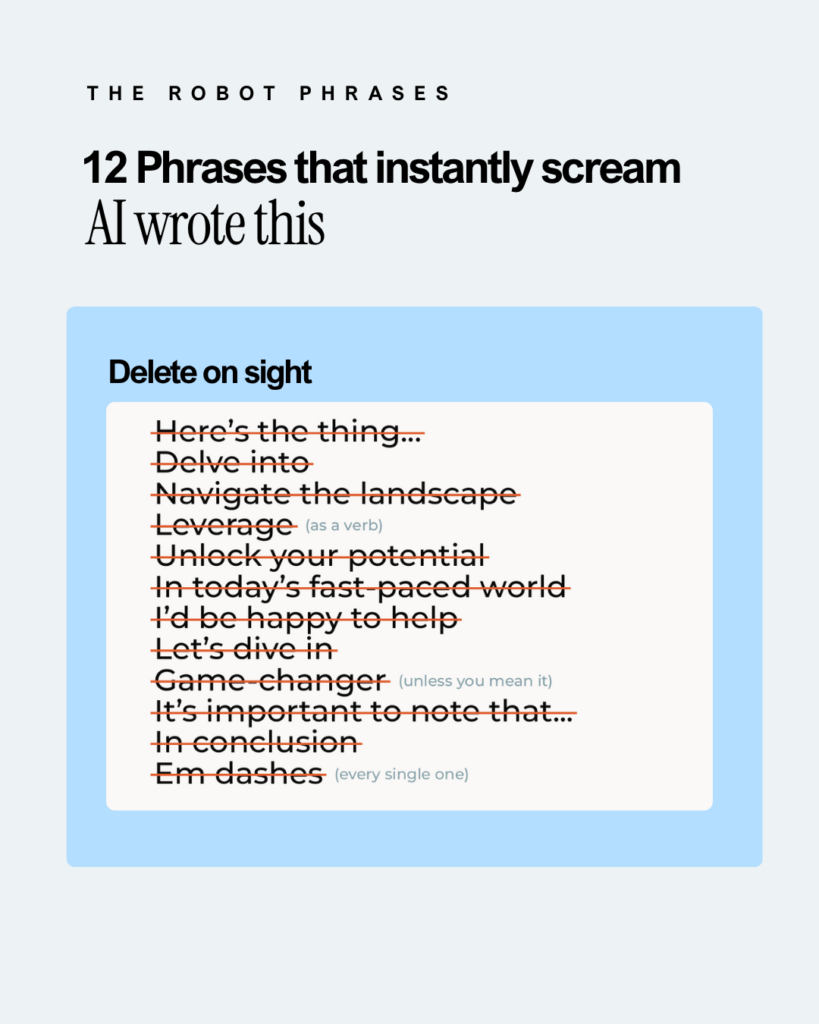
If you see these in your AI output, rewrite them. Or better yet, train your AI to avoid them in the first place by including a “never use these phrases” section in your Brand Book.
The Real Fix for All Five Mistakes
Notice how most of these mistakes come back to the same root cause?
AI doesn’t know you well enough.
That’s it. That’s the thread.
When AI understands your voice, your audience, your perspective, and your style, the outputs sound like you. When it doesn’t, they sound like generic robot content.
The single highest-leverage thing you can do is create a comprehensive Brand Book and use it as the foundation for all your AI work.
Not a 3-page brand guide. A real, deep document that captures:
- How you actually sound (with examples)
- Who you’re actually talking to (with psychographic depth)
- What you actually sell (with clear positioning)
- What makes you actually different (your hot takes and perspectives)
This document becomes the bridge between “AI that produces generic content” and “AI that sounds like you on your best day.”
Two hours of work. Hundreds of hours saved. Zero robot content.
Get the 2-Hour Brand Book here →
The Bottom Line
AI doesn’t make you sound like a robot. Using AI badly makes you sound like a robot.
The five mistakes:
- Letting AI generate your ideas instead of executing YOUR ideas
- No Brand Book or voice training
- Vague prompts that give AI nothing to work with
- Re-explaining everything instead of building trained assistants
- Publishing raw AI output without human review
Fix these, and your AI content will sound like you wrote it. Because you did—you just had help with the execution.
Your audience will never know. They’ll just think you got really prolific.
That’s the goal. 🔥
Related Reading:
5 AI Mistakes That Make You Sound Like a Robot (And How to Fix Them)