


The short version
Content stops sounding AI-generated when the idea underneath it is genuinely yours. Use AI for research, structure, and turning one idea into many formats. Keep the original thinking, the specific stories, and the actual opinions human. Then run one check before publishing: if your name were removed, would anyone still know you wrote it?
We pulled up to a chip truck a few weekends ago. Fish and chips, poutine, chicken wings, all the classics. There was a big board with a menu, and every single visual on it had been generated by ChatGPT.
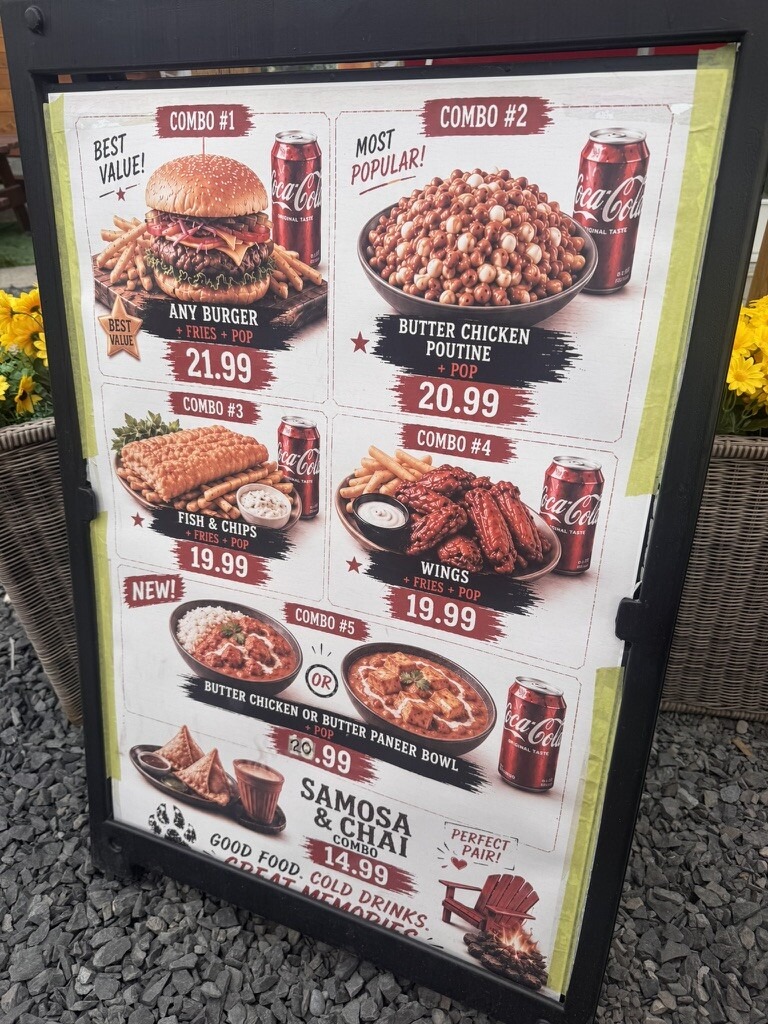
The burger looked like plastic. The fish and chips looked like a block of cheese. And the poutine? Well, it looked like strange wooden marbles. Seriously, zoom in on that pic.
My kids clocked it in about 4 seconds. Whenever we walk by anything these days that has that ChatGPT look, they say “check out how AI that looks, Mom”.
What stuck with me is that 2 years ago, that poster didn’t exist. Somebody would’ve hired a designer, or somebody would’ve taken actual photos of the fries. Now the fastest option, asking ChatGPT to create the menu, is also the one that tells every customer walking up that nobody at that chip truck really gives a shit.
That chip truck is doing the same thing a lot of very smart online businesses are doing right now (just with graphic design).
Below I’ll get into what actually flipped, why your buyers can feel it even when they can’t name what tipped them off, and the 3-question check I run on anything before it goes out. It takes about 30 seconds and it catches almost everything.
Why does AI-generated content turn people off now?
AI-generated content turns people off now because everybody is using the same tools, so the signal flipped. Looking or sounding AI-made no longer reads as fast or resourceful. It reads as nobody was home, which is the opposite of what you want a potential buyer to feel.
For about 3 years, using AI was an edge, mostly because most people weren’t. That window has closed. Your competitors have the same tools you have, at roughly the same price, producing roughly the same quality of output.
When everyone has access to the same production capability, the thing that stands out is no longer polish. It’s evidence that a specific person with a specific point of view was involved.
And detection has become ambient. My kids are not media analysts. They spotted an AI menu from a moving car because the tells are now part of the visual vocabulary of anyone who spends time online. Your audience is doing that same instant read on your emails, your carousels, and your sales pages, whether or not they could explain what tipped them off. If you want the specifics, these are the AI writing tells your audience picks up on fastest.
What actually became scarce when AI made content free?
Ideas became the scarce thing. Production used to be the bottleneck in content marketing, and now it costs almost nothing, which means the constraint moved upstream to the one thing AI cannot manufacture: having something worth saying in the first place.
Think about what used to take the time. Writing the email. Building the landing page. Editing the video. Designing the carousel. That was the expensive, slow, skill-gated part of the process, and it’s where most of us built our competitive advantage.
All of it is now cheap and instant. Which is great, and I use AI for all of it every single day. But if the expensive part of the work is free, then the value has to live somewhere else, and it lives in the input.
Your unique ideas. Your actual experience. The opinion you’re willing to defend when someone in your comments disagrees. That is the scarce raw material now, and no tool generates it for you.
How do you make time to come up with original ideas?
Protect empty space in your calendar and treat it as a business input rather than a reward. If every working hour is spent executing, you have nothing original to feed your AI tools, and they will confidently produce polished nothing with your name on it.
I run a multiple 7-figure business in about 25 hours a week and take 10 weeks off a year. People usually assume the systems are what make that possible, and the systems help, but that’s not the real mechanism.
The real mechanism is that the empty space is where the ideas come from. Long walks, my Friday strategy sessions, notebooks full of half-formed thoughts. I do most of my best thinking with pen and paper before Claude ever sees a word of it.
If you’re a coach, a course creator, or any kind of expert building a business on your thinking, this stops being a self-care conversation. Your ideas are the product. A calendar with zero room to generate them is a supply chain problem.
So block the time before you block anything else. Journal, walk, talk into your voice memos, sit somewhere without your phone. Whatever gets ideas out of your head and onto a page.
What should you actually be using AI for?
Use AI for everything downstream of the idea. That means pressure-testing your argument, finding research that supports it, and turning 1 strong thought into a YouTube script, a newsletter, a carousel, and a week of reels.
This is where AI earns its keep, and it’s why I’m not remotely anti-AI. I’m anti-outsourcing-your-thinking.
Here’s the sequence I use. I come up with the idea myself, usually on paper. I bring it to AI to poke holes in it, find the counterargument, and dig up the research that backs it up. Then I hand it off to be turned into every format I publish in.
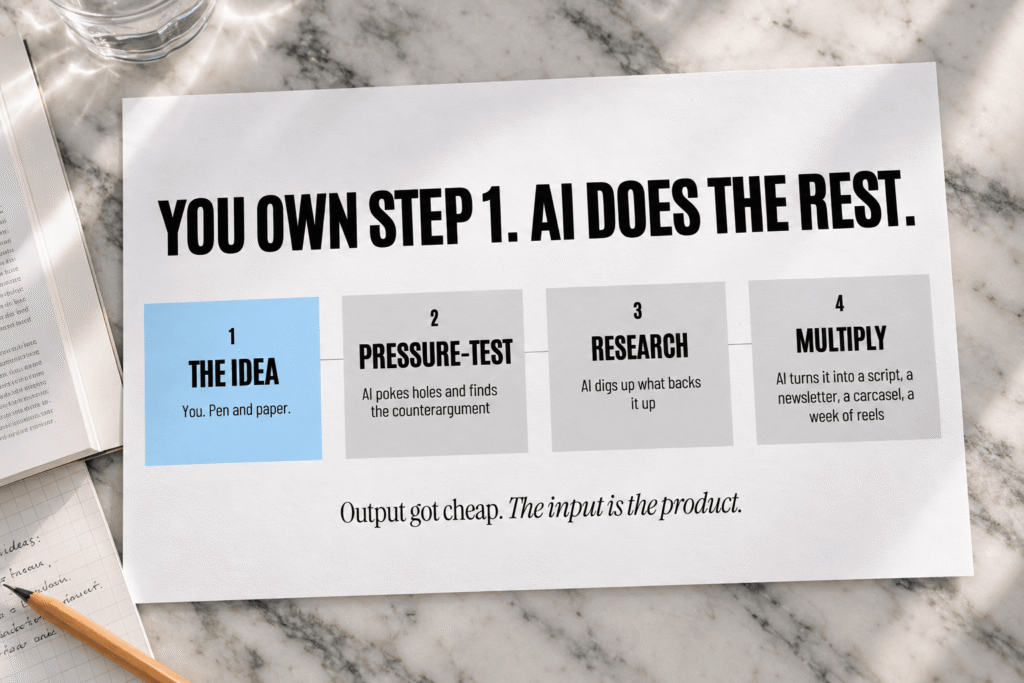
That last step only works if you have already trained AI to write in your brand voice, with the best practices for each format baked in. A YouTube script has a completely different structure than an Instagram carousel, which is nothing like a sales email. Generic AI gives you generic output because you handed it nothing to work with beyond a sentence. The fix is a documented brand book your AI tools can actually reference.
This is exactly what we build for people inside AI All Stars. The formats, the frameworks, and the voice are already baked in, so the multiplication step expands your idea instead of flattening it into the same beige paragraph everyone else is publishing. Whatever you build it in, though, the tools sit downstream. None of it works if the idea you hand them wasn’t yours to start with.
How do you know if your content has soul?
Read your draft out loud and ask whether it’s yours, not whether it’s good. AI output reads as competent, and competence feels like finished, which is precisely how so much slop gets published by genuinely smart people.
Good is the wrong bar now. Everyone can produce good. The question that matters is whether someone could strip your name off this piece and still know it came from you.
You will know within 2 sentences of reading it aloud. That gut reaction is faster and more accurate than any checklist, so trust it. If something feels flat and you can’t articulate why, the feeling is still correct.
When you need to diagnose what’s missing, 3 questions usually surface it:
- Is there a specific name, place, number, or story in here that only I could have included?
- Is there an opinion someone could actually disagree with?
- Is there at least one sentence that would sound wrong coming out of anyone else’s mouth?
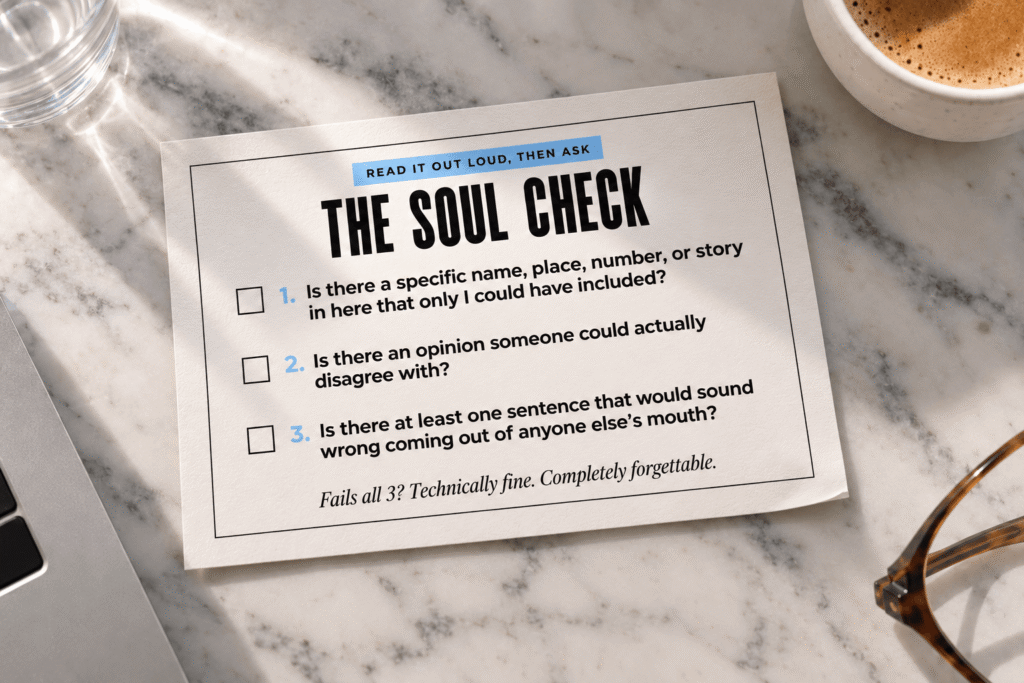
A piece that fails all 3 is technically fine and completely forgettable. That’s the exact combination that quietly costs you sales, because nothing in it gives a reader a reason to trust you over the 40 other people in their feed saying similar things.
Why does messy content build more trust than polished content?
Messy content builds more trust because visible imperfection signals that a real person is behind the business. Phone-shot video, natural light, unscripted delivery, and a slightly awkward first take all read as evidence of a founder, while flawless production increasingly reads as automated.
This is a real reversal. Overly polished content used to signal that you were established and worth taking seriously. Now it can trigger suspicion, especially with younger buyers who have watched AI video get good enough to fool them.
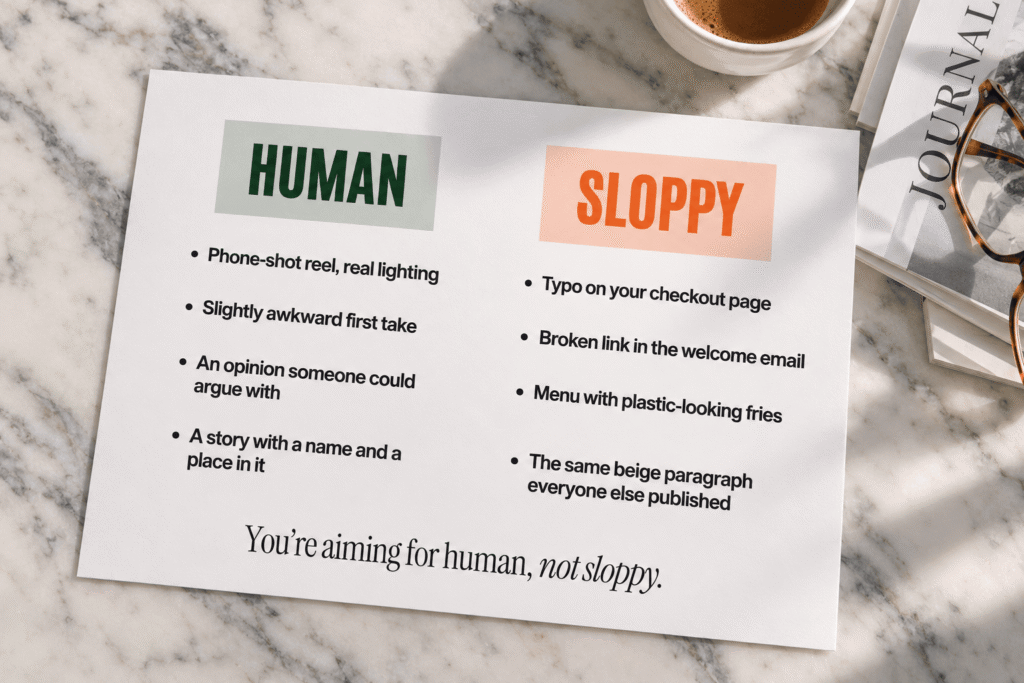
One important distinction, because this advice gets misread constantly. Intentionally unpolished is not the same as careless. A phone-shot reel with real lighting and a real face builds trust. A typo on your checkout page does not. You’re aiming for human, not sloppy.
| Reads as human (builds trust) | Reads as careless (costs trust) |
|---|---|
| Phone-shot video in natural light | Typos on your checkout page |
| An unscripted, slightly awkward first take | Broken links in your email sequence |
| A specific story with real names and numbers | Numbers you never checked before publishing |
| An opinion someone could argue with | A sales page that contradicts your offer |
| Your actual face on camera | Plastic-looking AI images of your own product |
Does this apply to faceless brands without a founder?
Faceless brands are a different case. Consumer brands like The Ordinary or Poppi have no thought leader for an audience to connect with, so their trust is built through branding and product rather than through personality, which changes what AI can safely do for them.
Those brands can use generated imagery and video far more freely than you can, because nobody opens their feed expecting to meet a specific person. The visual rules are different when there’s no face to be absent.
What does not change is the writing. A faceless brand still needs a distinct voice with actual personality, or it blends into every other product account with a clean grid. The rule shifts from “show the human” to “sound like something,” but the underlying requirement is the same.
If you’re a personal brand, though, you’re the entire differentiator. There is no version of this where you generate your face, your stories, and your opinions and still get the trust that closes sales.
Frequently asked questions
Using AI for content marketing is fine and increasingly standard. What costs you is letting AI generate the ideas and opinions rather than the execution, because that’s the part your audience is buying.
People spot AI content through pattern recognition rather than any single tell. Generic examples, no specific names or numbers, no defensible opinion, uniform rhythm, and imagery with that plastic, over-smooth look.
Disclosing AI use is usually not required, but be ready to say yes if someone asks. The EU AI Act’s transparency rules took effect on 2 August 2026 and mostly cover deepfakes and AI-generated text published to inform the public on matters of public interest, not ordinary marketing copy. There is also a carve-out for anything a human has properly reviewed and taken editorial responsibility for. Worth a conversation with a professional if you sell into the EU. For most personal brands, being straightforward when someone asks matters more than adding a badge to everything.
Add 1 specific detail only you could know and 1 opinion someone could argue with. That alone separates most content from the generic version of itself.
The takeaway
AI made output free, so the value moved to the input. The businesses that will win the next few years are the ones run by people who protect time to think, then use AI to multiply what they came up with.
Before you publish anything this week, read it out loud and ask whether it’s yours. If the answer is no, the fix is not a better prompt. It’s a better idea, and that part still has to come from you.
I write about this kind of thing every Thursday in Noted, my weekly newsletter on AI, marketing, and building a business that fits your life. Come get it in your inbox.
Where to go next
- How to Use AI in Your Online Business (Without Losing Your Voice): the bigger map this fits into
- How to Train AI to Write in Your Brand Voice: so the multiplication step sounds like you, not the tool
- 5 AI Mistakes That Make You Sound Like a Robot: the specific tells your audience is picking up on
- The Brand Book: The Missing Piece in Every AI Assistant: what to train into your tools before you hand them an idea
Does Your Content Have Soul? The New Marketing Test