Answer engine optimization (AEO) is the work of getting AI to name your business when someone asks them for a recommendation. It comes down to 3 things: describing yourself the same way everywhere online, covering 1 narrow topic more deeply than anyone else, and earning mentions on websites you don’t own.
Let me back up…
Somewhere right now, your ideal client is getting ready to hire someone like you.
Maybe she’s 6 months out from her wedding. Maybe she finally decided this is the year she gets the pantry, the garage, and her inbox under control. Maybe she’s been told she needs a nutrition plan and doesn’t want to figure it out alone.
A few years ago, she would’ve typed a few words into a search bar and started scrolling. Now there’s a real chance she opens AI instead and asks it like she’d ask a friend: “Who should I hire for this? Give me your top 3 and why.”
She gets 3 names back, each with a little explanation. She checks out 2 of them. She books a call with 1.
If your name wasn’t in that answer, you weren’t option number 4. You were invisible. There’s no page 2 of an AI answer.
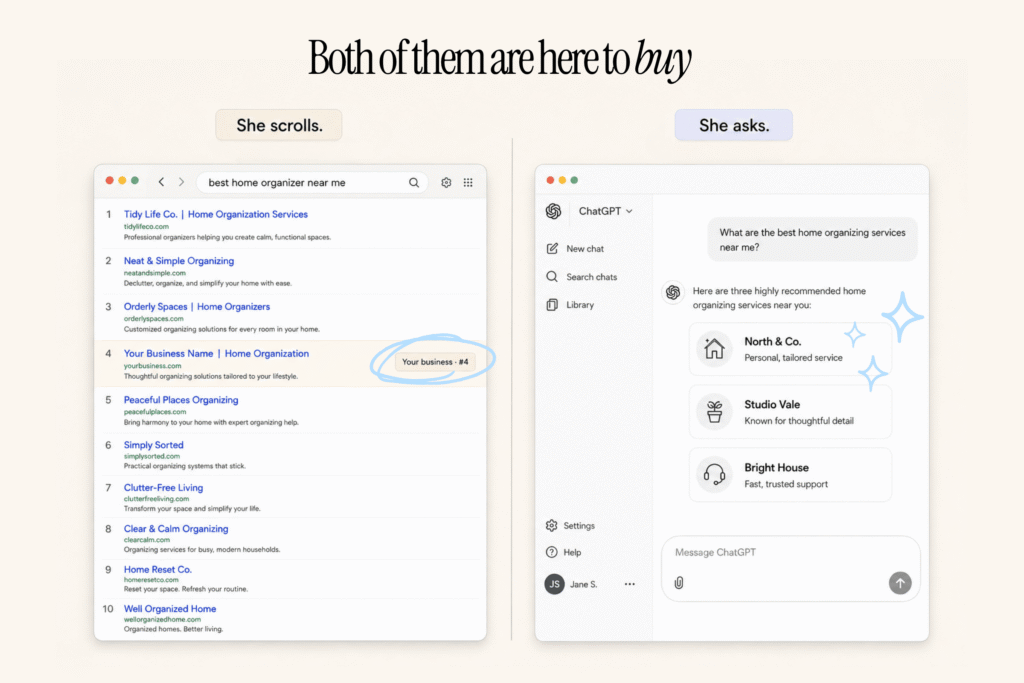
I’ve been saying for a while that SEO as we knew it is fading as the front door to your business. That doesn’t mean the work you’ve put into your website was wasted, because it wasn’t, and we’ll get to why. But it does mean a new layer got added on top: it’s no longer just “can people find you,” it’s “does AI recommend you?”
The good news? Almost nobody in your niche is doing this work yet. You’ve got a chance to get the headstart.
So here’s the full walkthrough: what this new game is, a free 10-minute audit that shows you exactly where you stand, and the 3 moves that get AI saying your name.
What is answer engine optimization (AEO)?
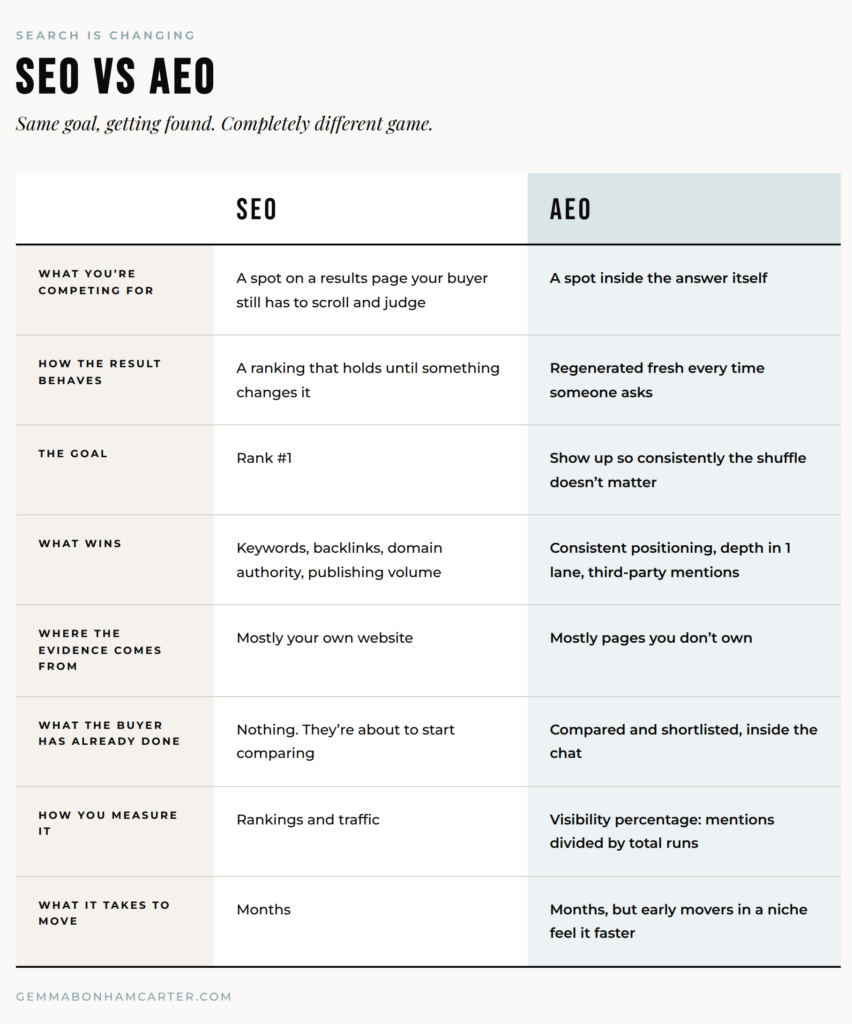
Answer engine optimization is the work of making your business one of the answers AI assistants give when your ideal client asks for a recommendation, a comparison, or a plan. SEO earned you a spot on a results page that someone still had to scroll and judge. AEO earns you a spot inside the answer itself, which is increasingly the only thing your future client reads.
And the visitors who do click through from an AI answer are a different breed. By the time someone lands on your site from an AI conversation, the comparing and shortlisting already happened inside the chat. Search software companies have measured those visitors converting at several times the rate of regular search traffic, and while I’d hold any exact multiple loosely (the studies come from companies selling search tools, after all), the direction matches what you’d expect: these people arrive pre-sold.
Here’s what makes AEO a different game from the SEO you’re used to, though. AI answers aren’t a ranking. They’re regenerated fresh every single time someone asks.
When researchers at SparkToro had 600 volunteers make close to 3,000 runs of the same prompts through the major AI LLMs in January 2026, the odds of getting the same list of brands twice came back at less than 1 in 100. The names shuffle constantly. But, and this is the part that matters, a small number of brands showed up almost every single time. One appeared in 97% of the answers in its category.
So the goal was never “rank #1,” because there’s no #1 to rank for. The goal is to be in the answer so consistently that the shuffle doesn’t matter. That’s what the 3 moves below are for.
What’s the difference between SEO and AEO?
SEO is about earning a spot on a results page your buyer still has to scroll and judge. AEO is about earning a spot inside the answer itself. SEO rewards keywords, backlinks and publishing volume. AEO rewards consistent positioning, depth in one lane, and mentions on pages you don’t own.
Why does AI recommend your competitors instead of you?
Because AI only recommends businesses it’s confident about, and confidence comes from consistency. Every AI assistant has already built its own version of who you are, assembled from everything it can find: your website, your social profiles, your directory listings, what other people say about you. When those signals conflict, or barely exist, it quietly skips you, no matter how good your actual work is.
Think of it like a reference check. When someone’s deciding whether to hire you and they call 3 references, the best outcome is all 3 describing you the same way. Same strengths, same story. That agreement is what creates confidence.
That’s exactly what AI is doing with your business, at scale, across the whole internet. If your website says “holistic wellness coaching,” your social bio says “nutrition for busy moms,” and a 4-year-old directory listing says “personal training,” the AI doesn’t average those into something flattering. It just gets unsure. And unsure businesses don’t make the answer.
The fix starts with knowing what it currently believes.
What does AI actually believe about your business?
Find out by asking it directly. Open 2 or 3 AI LLMs, ideally the ones your clients are most likely to use, and run the same short audit in each one. Vague, wrong, or conflicting answers are your first fix, and it’s usually an afternoon of work, not a rebrand.
Run this prompt in each one:
The audit prompt
I'm researching a business called [your business name] at [your website]. Answer 3 things:

1. What does this business actually do?
2. Who is it for?
3. What makes it different from the alternatives?

If you're not confident about any of these, say so instead of guessing.
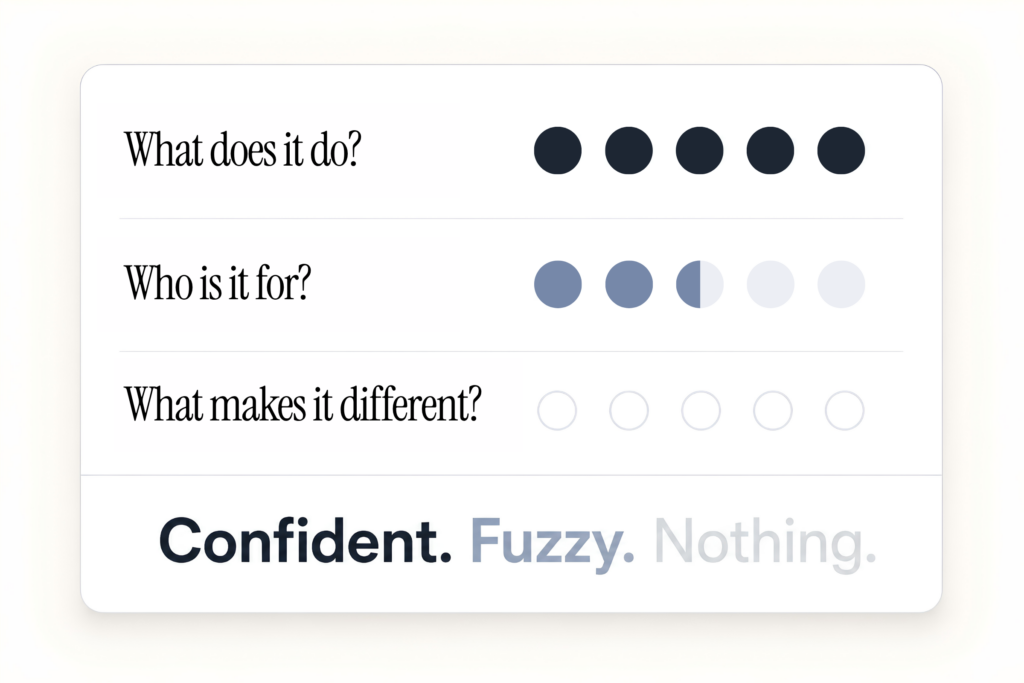
Then run the exact same prompt on your closest competitor. That comparison is where it gets motivating, I promise.
Now grade what came back. You’re looking for 3 things: is it accurate, is it specific, and is it the same across all the AIs you asked? A wrong category (you’re a retailer, it thinks you’re a manufacturer; you’re a coach, it thinks you’re a course marketplace) is the worst version of this, because it means AI isn’t even putting you in the right lineup when buyers ask.
The fix is boring, and boring is the point. Write down your 3 lines: what you do in 1 or 2 sentences, exactly who it’s for, and the 2 or 3 things you want repeated about you every time. Then make every place that describes your business match, nearly word for word: your website, your about page, every social bio, your directory listings, the bio you send podcast hosts, your email footer. If you can’t say those 3 lines cleanly yourself, AI has no chance, which is exactly the job my 2-Hour Brand Book exists to do: it gets your positioning, audience, and voice out of your head and into words you can use everywhere, consistently.
Consistency feels repetitive from the inside. From the outside, it reads as confidence. AI agrees.
How do you become the answer instead of 1 of 20 options?
Pick 1 lane, meaning the specific set of questions your best clients ask on the way to hiring someone like you, and cover it more deeply than anyone else, with material only you can supply: your own results, your own numbers, your own way of doing things.
For years the content advice was “publish more.” Feed the algorithm, stay consistent, volume wins. In AI search, the evidence points somewhere else. Google has held a patent for scoring content by “information gain” since 2022, which is a fancy way of saying: how much does this page add beyond what the reader has already seen? A page that restates what the top results already say scores near zero, no matter how nicely it’s written. And when Semrush and Kevin Indig tracked more than 50,000 brands across 1,094 topics in AI answers through the first half of 2026, they found that in roughly half the topics, the brand winning wasn’t the one with more traffic or higher domain authority. Traditional SEO strength alone didn’t explain who owned the answer.
Deep and specific beats big and general. Which is honestly the best news a small business has gotten in a decade, because deep and specific is the one game you can win against companies 100x your size.
What a lane looks like in practice:
- A wedding planner owns “planning a backyard wedding”: the permits question, the tent question, the rain plan question, the real budget breakdown from her last 12 backyard weddings
- A professional organizer owns “decluttering garages”: best practices, how long each phase really took across 30 client homes, the 2 mistakes every client makes
- A bookkeeper owns “cleaning up 2 years of messy books”: what the process actually involves, real (anonymized) before-and-afters, her honest take on when DIY software is enough
Notice what makes each of those citable: original data, firsthand experience, and a real opinion. Every piece you publish in your lane should contain at least one thing that exists nowhere else on the internet. That’s the bar now. If you have one offer and one audience, this is genuinely easier for you than for a big brand, because everything you publish naturally stacks in the same lane.
Why do other people’s websites matter more than yours?
How you are referred to on other websites matters. AI treats what others say about you as stronger evidence than what you say about yourself. Studies of AI citations keep landing on the same pattern: most brand mentions in AI answers, 85% in AirOps’ 2026 State of AI Search report, come from pages the brand doesn’t own. Roundups, comparison posts, reviews, community threads. (That study comes from a visibility-software company, so again, hold the exact number loosely. The direction is what matters, and it’s not subtle.)
This isn’t even new logic. Google’s own quality rater guidelines have told human reviewers for years to be skeptical of what a website says about itself and to look for independent reviews, references, and expert recommendations instead. AI answers inherited that instinct. Your website makes you legible. Other people’s websites make you believable.
So the third move is building mentions you don’t control:
- Pitch the roundups. Find the “best [what you do] for [who you serve]” articles that already exist in your niche and pitch yourself, with a reason you belong there. Those list posts are exactly the format AI loves to cite.
- Be a guest. Podcasts, newsletters, and blogs in your niche all create third-party pages that describe you in someone else’s words. One good guest spot outworks 5 posts on your own site for this particular job.
- Collect reviews where your clients talk. Public reviews and testimonials on platforms you don’t own are reputation signals AI can read.
- Show up usefully in communities. Forums and groups where your ideal clients ask for recommendations feed AI answers. Answer the actual question generously and skip the pitch. A helpful answer with your name attached compounds. A drive-by promo gets you banned and does nothing.
How do you track this without buying anything?
With a spreadsheet and about 15 minutes a month. Write 10 prompts your ideal client would realistically ask, run each one in 2 or 3 AIs once a month, and log whether you got mentioned. The number you watch is your visibility percentage: mentions divided by total runs.

Make the prompts span the whole buying journey, because different stages surface different names. Something like: 3 problem questions (“how do I stop my toddler waking at 5am”), 4 comparison questions (“best sleep consultants for toddlers, and what do they charge”), and 3 decision questions (“is [your name] legit? what do her clients say?”).
One warning from that SparkToro research: don’t panic over any single run. Answers shuffle every time. A single check means nothing, which is also why I wouldn’t rush to buy a visibility tracking tool on day one. You want to see the positive trend across months.
What should you do first?
First step is to run the audit above this week. It’s 10 minutes, it’s free, and everything else depends on what it tells you.
Then, in order:
- Fix your 3 lines everywhere. What you do, who it’s for, what makes you different. Same words on your site, bios, and listings. 1 afternoon.
- Pick your lane and publish 1 deep piece. Pick one question your best clients always ask and answer it in an article on your website with something only you have: your data, your process, your honest take.
- Earn 1 mention a month you don’t own. Aim to get mentioned elsewhere. A roundup pitch, a podcast guest spot, a community answer that solves someone’s problem. It compounds over time.
- Start the tracking sheet. 10 prompts, once a month, watch the trend for a positive uptick.
None of this requires a new tool, a developer, or a big audience. It requires clarity and a little consistency.
Frequently asked questions
Does this replace SEO?
No, it sits on top of it. A well-structured site with clear pages is still the foundation AI reads, so don’t torch what’s working. What changes is where you point new effort: consistency, depth in one lane, and third-party mentions now beat publishing thin posts for 20 keywords.
How long before I see results?
Think months, not days, with a caveat: because so few small businesses are doing this deliberately, the early movers in a niche tend to feel it faster than SEO ever moved.
My business is local. Does this still matter?
It matters even more! “Who should I hire near me” questions are exactly what people ask AI, and the answers lean hard on directory consistency and reviews.
Can I just use AI to write a pile of content for my lane?
You can use AI to help assemble it, sure. But the thing that gets cited is the part AI can’t invent: your numbers, your client patterns, your opinion. AI-drafted content with nothing of yours in it is exactly the “adds nothing new” content that scores zero.
Should I update old posts or write new ones?
Update first. Give your best existing posts a direct answer under each heading, add your own data and a short FAQ, and align them with your 3 lines. A strong post you improve usually beats a new thin one.
The short version
Your ideal client is starting to ask AI who to hire, and AI only recommends businesses it’s confident about. Confidence comes from 3 places: you describing yourself the same way everywhere, you covering your lane more deeply than anyone else with material only you have, and other people vouching for you on pages you don’t own.
Run the audit. Fix your 3 lines. Go deep in one lane. Earn mentions. Track it monthly with a spreadsheet.
That’s the playbook, and probably almost nobody in your niche is running it yet.
Where to go next
- How to Use AI in Your Online Business: the bigger map this fits into
- Train AI to Write in Your Brand Voice: so the content in your lane sounds like you
- Turn a PDF Into an Interactive Lead Magnet: an example of owning a lane with original depth
- The Report You Build Every Week Can Now Build Itself: hand the recurring checks to AI
And if the audit shows you a business AI can’t describe that’s fixable faster than you think. AI All Stars is where I teach the full system: an AI dream team trained on your business, built on the kind of clear positioning that makes both AI and humans confident recommending you. We hand you all of my custom-built skills, including some specifically that write articles for good SEO/GEO and to help you map out changes you need to make to your website to better show up in AI search. Start with my free AI workshop and see how this approach feels. Ready when you are.
AEO for Small Business: Your Next Client Isn’t Googling You