


To write a client proposal with AI, attach your discovery call transcript to Claude along with a brand book and a strategic proposal skill, then ask for a designed proposal priced with 3 options. The skill pulls your client’s own words, the cost of their problem, a strategy and your pricing into 1 page that you review before it goes out.

The gap between a great discovery call and the proposal landing in your client’s inbox is where a lot of deals quietly die. Your potential client gets off the call feeling understood and ready to move, then 3 days go by while you find time to write it up, and the person reading your proposal on Thursday isn’t nearly as fired up as the person you talked to on Monday.
I built this workflow so the proposal goes out the same day and actually sounds like I was listening. I’ve spent 15 years in marketing and taught 23,000 entrepreneurs, and this year I ran a launch that did $470,000 on under $10,000 in ad spend with every email written by my Claude skills. The proposal skill in this article is built the same way, with everything a strong strategic proposal needs already inside it.
What do you need set up in Claude before it can write a proposal?
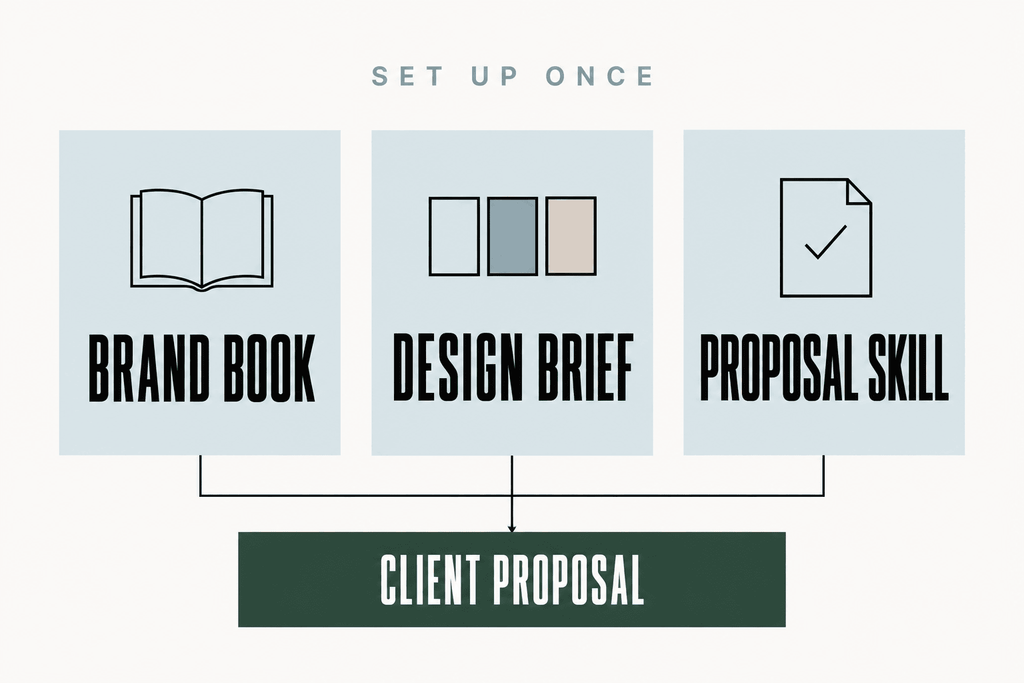
You need 3 things in place: a brand book skill, a design brief skill, and a strategic proposal skill.
The brand book and design brief are what stop Claude from handing you a template. Claude reads them before it builds anything, so the proposal page uses your voice, your colors and your way of explaining things instead of a generic layout with your logo dropped on top.
The skill is the part most people are missing. A skill is a set of instructions you give Claude once, so it knows how to do a specific job well every single time without you explaining it again in every prompt. My strategic proposal skill knows how a proposal that closes is built: it uses the client’s own words, it shows what the problem is costing them before it ever shows a price, and it gives them options instead of a single number.
🎁 Want to see the full system behind this? I walk through the rest of my skills and exactly how I set them up in my free AI workshop. Grab the free AI workshop here.
What goes into the transcript you give Claude?
The raw transcript from your discovery call goes in exactly as it is, rambling and all, because that’s where the specifics live.
For the demo, I used a sample discovery call I put together so I could show the whole process without sharing a real client’s business. In it, I’m playing an AI implementation consultant talking to Sam, who owns a med spa in Ottawa called Lumen Medical Aesthetics and has a team of 6. She’s writing Instagram captions at 10 at night, she spent $15,000 on an agency that made her content sound like nobody, and she wants to open a second location, but the business doesn’t run without her in the building.
The call jumps around the way a real call does, and that’s the point. Sam names her budget, her deadline, her team and the agency that let her down, which gives the proposal real material to pull from. Download the transcript as a PDF and attach it rather than pasting it in, so your prompt stays short and readable.
What prompt do you use to turn a call into a proposal?
The prompt is 2 short paragraphs that name the client, attach the transcript and call on 2 skills by name.
Here’s the exact prompt from the demo:
Prompt
Attached is the transcript from a discovery call with a potential client, Sam, who owns a med spa called Lumen Medical Aesthetics.
Use my strategic proposal skill and my design brief skill to build a designed, interactive proposal page for her. Price it using the 3 options I described on the call and the budget she shared.
This prompt is short on purpose, and the only reason it can be this short is the skills. I’m not explaining how to write a proposal, how to price it or how to design the page, because the skills already know all of that. Naming each skill in the prompt tells Claude exactly which ones to pull in, and the pricing comes from the call itself, so you don’t need a separate offer suite loaded for this one.
What should an AI-written client proposal include?
A proposal that closes includes the client’s own words, what the problem is costing them, a clear strategy, 3 pricing options and 1 final review from you.
Here’s how each of those showed up in the proposal Claude built for Sam, and why each one matters.

1. The client’s own words
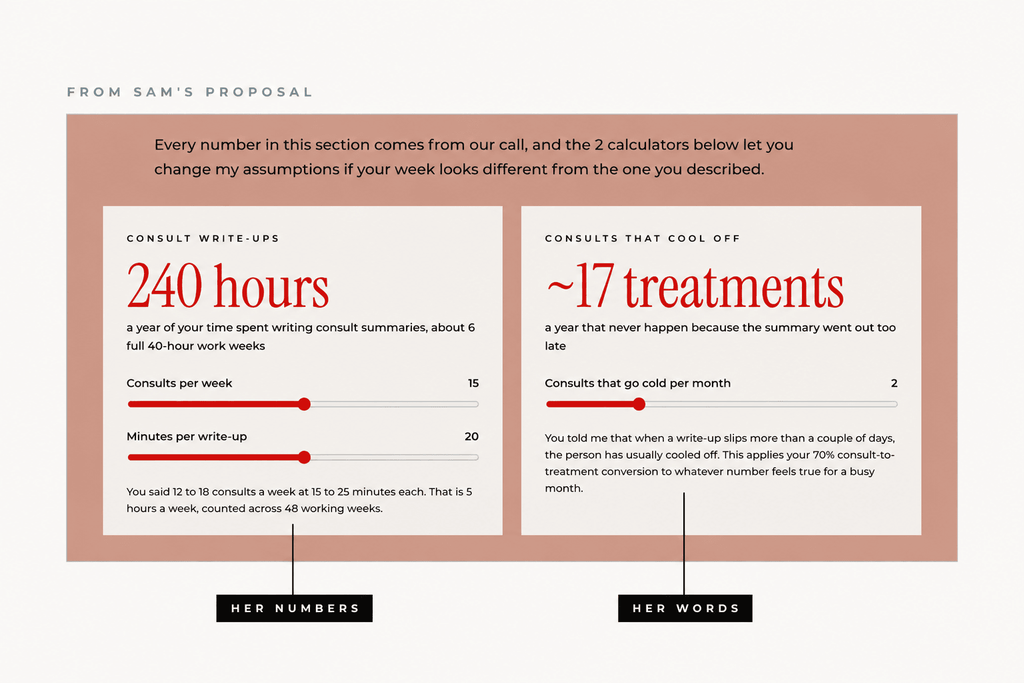
The first thing I check in any proposal is whether it sounds like it was written for this specific person. The skill is built to pull the client’s exact phrases from the call back into the document, so the opening section quotes Sam directly. Nothing proves you were listening like reading your own words in somebody else’s proposal.
2. What the problem is costing them
This is the section most proposals skip completely. The skill lays out what staying stuck is costing the client right now, using specifics from the call, like the $15,000 agency that didn’t work out or the second location she keeps pushing back. It shows up before any price, so by the time the client sees a number, they’ve already done the math on what doing nothing costs.
3. A strategy that shows you’re the strategist
The strategy section is what makes you look like a strategist instead of a vendor. The skill gives away the what and the why, and holds back the how, so the client can see that you know exactly what to do while still needing you to do it.
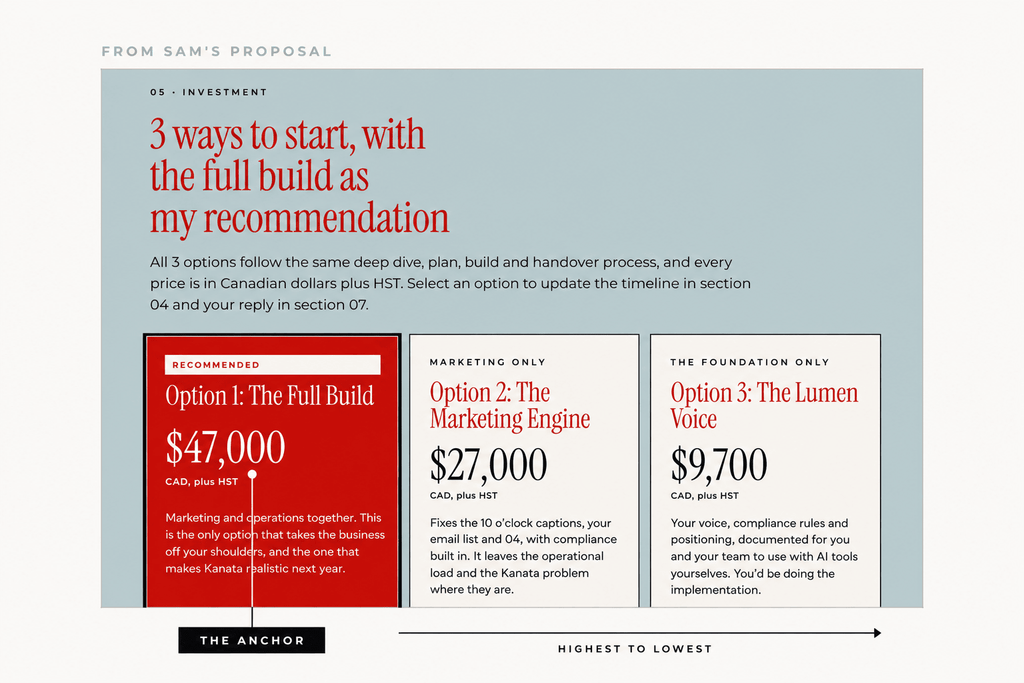
4. 3 pricing options, highest first
The investment section gives 3 options instead of 1 number, ordered from highest to lowest so the first price the client sees sets the anchor. Sam said on the call that she’d landed somewhere between $30,000 and $50,000, and the skill built the recommended option around that range. It also left a placeholder for a client result next to the price instead of inventing one, and it added a note under the page explaining what it priced at, why, and anything the call didn’t cover, so you can adjust before anything goes out.
5. 1 review pass before it goes out
Your judgment still matters, and this is where it comes in. I always do 1 review pass before a proposal reaches a client, and if a section reads too generic, I ask Claude to change it in 1 line, such as “Make the next steps tie to her October deadline for Q4.” In the demo, that edit took about 30 seconds.
Why does this work when most AI proposals read like a template?
It works because Claude starts from your source of truth and a skill that already knows how proposals close, so the only thing left to fill in is what’s specific to this client.
Those are the first 2 steps of what I call The HIRE Method. The H is house your source of truth, which is my brand book and design brief, so the proposal sounds and looks like my business. The I is where the skills come in, so I’m not prompting from scratch, because the strategic proposal skill already knows how to structure, price and write a proposal that closes. If you’re starting from scratch, those are the 2 things to set up first, and skills like this one are exactly what I build and teach inside AI All Stars.
Will your client be able to tell AI wrote the proposal?
Your client will notice that you were listening, because the proposal quotes them, names their deadline and prices against the budget they gave you.
Clients can already tell when a proposal is generic, and most generic proposals were written by a very tired human at 11 at night, copying last month’s proposal and hoping they caught every spot with the old client’s name in it. That was never a robot problem. It was a template problem, and a skill that pulls from the actual call is what fixes it.
Frequently asked questions
Do I need to paste the whole transcript into the prompt?
No. Download the transcript as a PDF and attach it, which keeps the prompt short and lets Claude read the full call.
Where does the pricing in the proposal come from?
It comes from the call itself. The prompt tells Claude to use the options you described on the call and the budget the client shared, so you don’t need a separate offer document for it.
Will Claude make up client results to support the price?
In the demo, the skill left a placeholder for a client result beside the price instead of inventing one, which is exactly what you want. You fill it in with a real result before you send it.
Do I still need to review the proposal myself?
Yes. Do 1 review pass, fix anything that reads generic with a 1-line request, and then send it.
What should I set up first if I don’t have any of this yet?
Start with a brand book and design brief, then add a strategic proposal skill. Those 2 pieces do the heavy lifting, and they’re what let your prompt stay this short.
Your next step
If you’re still writing proposals from scratch, or not sending them at all because you never find the 3 hours, this workflow fixes both problems: attach the transcript, name your skills, review once and send it the same day. The fastest way to see how all of my skills fit into a business like yours is my free AI workshop, so watch it before your next discovery call and let your proposal land while your client is still excited.
Where to go next
- How to Keep Up With AI Without Rebuilding Everything: Why skills you build once keep paying off, the same idea that makes this proposal prompt so short.
- Does Your Content Have Soul? The New Marketing Test: How to make sure anything AI writes for you still sounds like you.
- How to Make Instagram Carousels With AI That Still Look Like Your Brand: Another workflow where your brand book and design brief do the heavy lifting.
- The Report You Build Every Week Can Now Build Itself: One more job Claude can take off your plate once it’s set up.
How to Write a Client Proposal With AI Using Your Discovery Call Transcript